Spring vs. Hydraulic Cone Crusher: Which is the Real Money-Maker for Your Quarry?
If you are running a quarry or an aggregate plant, choosing the right cone crusher is probably one of the biggest decisions you’ll make. It’s not just about the upfront cost; it’s about your daily operational cost, uptime, and ultimately, your profit margin.
When you browse manufacturer catalogs, you will inevitably face the classic dilemma: Spring Cone Crusher vs. Hydraulic Cone Crusher. One looks like a rugged, time-tested beast, while the other looks like a sleek, modern tech marvel. But which one actually fits your specific production line? Let’s strip away the corporate marketing jargon and look at the real, hard-core facts from the field.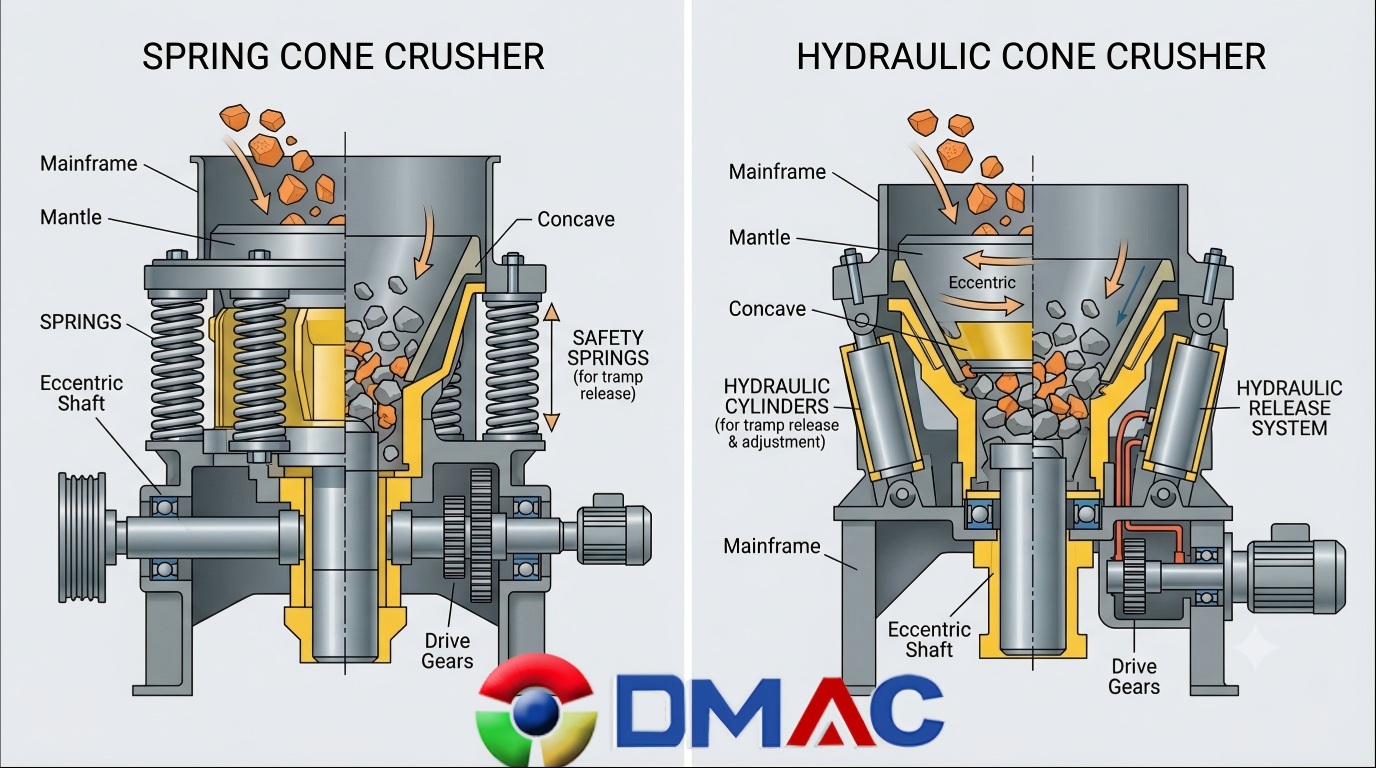 The "Old Reliable": Spring Cone Crusher (Symons Type)Let’s start with the veteran. The spring cone crusher (often referred to as the Symons type) has been the backbone of the mining and aggregate industry for decades. If you visit older quarries in South America or Southeast Asia, you’ll still see these machines pounding away after 20 years.
Why People Still Love It:
1.It’s Practically Bulletproof: The structure is purely mechanical and incredibly robust. It doesn't rely on complex electronics.
Easy to Fix in the Middle of Nowhere: If something goes wrong, a local mechanic with basic tools can usually figure it out. You don’t need to wait weeks for a specialized automation engineer to fly in.
2.Lower Initial Investment: If you are starting a new plant on a tight budget, the spring cone crusher gets the job done without breaking the bank.
The Real-World Pain Points:
1.The "Tramp Iron" Nightmare: The springs are designed to let uncrushable objects (like a broken excavator tooth) pass through. But if a massive piece of iron gets stuck, the machine jams. Cleaning it out involves manual labor, sweat, and hours of costly downtime.
2.Adjusting the Discharge Opening is a Workout: Want to change your output size? Get ready to manually rotate the adjustment cap. It’s time-consuming and halts production.The "Smart Performer": Hydraulic Cone CrusherHydraulic cone crushers (divided into Single-Cylinder and Multi-Cylinder types) represent the modern evolution of crushing. They replace the heavy springs with advanced hydraulic systems and PLC automation.
Why It’s Worth the Premium:
1.One-Button Clearing & Adjustment: If the machine stalls due to a power outage or uncrushable material, you don't need crowbars. You press a button on the control panel, the hydraulic cylinders lower the main shaft to drop the material, and you are back in business in minutes.
2.Better Cubical Product Shape: Multi-cylinder hydraulic crushers use laminated crushing principles. Instead of just grinding rock against steel, it forces rock to crush against rock. This results in a much higher percentage of cubical aggregates—the exact high-quality shape that concrete and asphalt plants pay a premium for.
3.Higher Capacity in a Smaller Footprint: A hydraulic cone crusher can process significantly more tons per hour than a spring cone crusher of the same physical size.
The Reality Check:
1.Higher Initial Cost: The advanced technology comes with a higher price tag.
2.Sensitive to Dust and Maintenance: The hydraulic and lubrication systems require clean oil and strict maintenance. If your team is sloppy with oil filter changes, hydraulic valves will fail, and troubleshooting electronics requires trained technicians.Head-to-Head Comparison: The Cold, Hard DataTo make your decision easier, let’s look at how they stack up where it matters most
| Feature |
Spring Cone Crusher |
Hydraulic Cone Crusher |
| Initial Cost |
Low to Medium |
Medium to High |
| Operational Efficiency |
Average (80% - 85% uptime) |
Extremely High (90%+ uptime) |
| Output Quality (Shape) |
Standard |
Premium (More cubical, fewer flakes) |
| Tramp Iron Release |
Mechanical (Manual clearing if jammed) |
Automatic Hydraulic Cleared |
| Maintenance Skill Level |
Basic mechanical knowledge |
Advanced (Hydraulics + Electrical) |
The Verdict: Which One Should You Buy?
There is no "perfect" crusher, only the "right" crusher for your specific business model. Based on decades of helping clients build production lines, here is our honest recommendation:
Choose a Spring Cone Crusher if:
1.You are on a strict budget and need to minimize your initial capital expenditure.
2.Your project is in a remote location with limited access to high-tech spare parts or specialized technicians.
3.Your end-buyers don't care about perfect cubical shapes (e.g., standard road base material).
Choose a Hydraulic Cone Crusher if:
1.You are processing hard, abrasive rocks(like granite, basalt, or river pebbles) where downtime from wear and tear can ruin your profits.
2.Labor costs are high in your area, and you need maximum automation to reduce manual intervention.
3.You are supplying high-grade concrete or infrastructure projects(like highways or high-rise buildings) that demand strict cubical aggregate specifications.
Need a Custom Layout for Your Quarry?
Choosing between spring and hydraulic is just the first step. You also need to match it with the right jaw crusher for the primary stage, calculate the proper conveyor belt widths, and optimize your closed-circuit layout to prevent bottlenecks.
What type of rock are you crushing, and what is your target tons-per-hour? Leave a comment below or send us your project blueprint, and our engineering team will calculate the exact equipment configuration for your site!