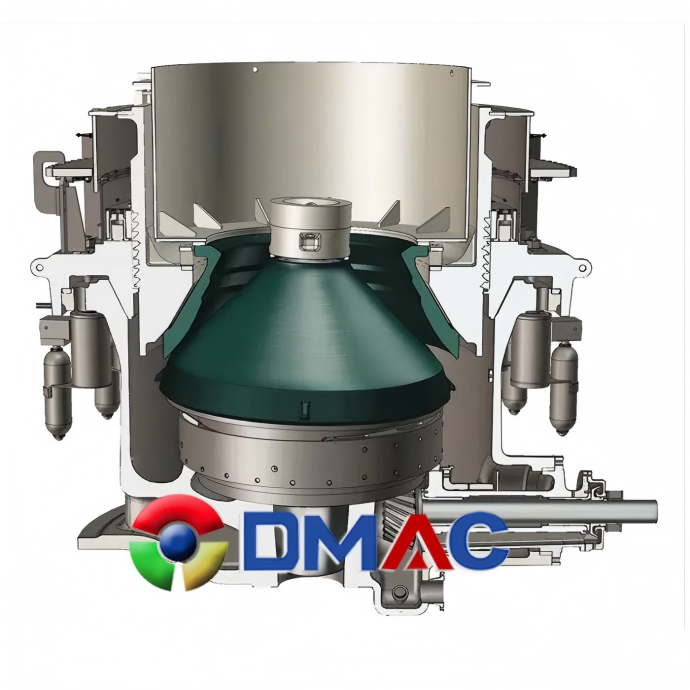
Differences Between Single-cylinder & Multi-cylinder Hydraulic Cone Crushers
Single-cylinder and multi-cylinder hydraulic cone crushers are widely used for secondary and tertiary crushing in mines and aggregate plants. They handle medium to hard rocks like granite, basalt and tuff, as well as metal ores including iron, copper and gold ore. Though both serve medium and fine crushing tasks, they differ a lot in structure, performance and application. Below is a clear comparison for your reference.
1. Structure & Working Principle Single-cylinder hydraulic cone crusher It has only one hydraulic cylinder at the bottom. The main shaft and mantle are integrated as one unit. The shaft hangs freely, supported by the bottom cylinder and socket liner. The eccentric sleeve drives the whole shaft to swing for crushing. This design is simple and compact. It has fewer parts, so it breaks down less often and is easy to maintain. Multi-cylinder hydraulic cone crusher Multiple hydraulic cylinders (6 to 10 in total) are fitted around the machine frame. The thick, short main shaft is fixed firmly to the frame and does not move. Only the mantle rotates and swings under the drive of the eccentric sleeve. The whole machine features high rigidity and strong load capacity. It stands up well to heavy loads and impacts from hard rock. 2. Discharge Opening Adjustment Single-cylinder model We adjust the discharge opening by lifting or lowering the main shaft. The hydraulic cylinder fills or drains oil to move the shaft up and down. The operation is simple and quick. Multi-cylinder model The mantle stays still during adjustment. A hydraulic motor or cylinder drives the adjusting ring, moving the concave assembly up or down in a spiral path. This method delivers higher adjustment accuracy and better locking performance, keeping output size consistent.
3. Tramp Iron Protection & Cavity Clearing Single-cylinder type When uncrushable material like iron enters the crushing cavity, hydraulic oil flows into the accumulator. The main shaft drops down to let the foreign object pass through safely. Once the blockage is gone, oil flows back and the machine returns to normal. We also use the hydraulic system to clear blocked cavity easily. Multi-cylinder type All surrounding hydraulic cylinders release pressure at the same time when overloaded or meeting tramp iron. The concave rises to widen the opening and discharge foreign materials. One single block will not affect the whole machine. If the cavity gets blocked, you can clear it with one click to release pressure from all cylinders. It saves plenty of downtime.
4. Crushing Performance & Application Single-cylinder hydraulic cone crusher It boasts large feeding capacity and works great for secondary crushing. It suits medium-hard stone, weathered rock, river pebble and limestone. It helps keep your operating cost low. Multi-cylinder hydraulic cone crusher It adopts the interparticle crushing principle. With higher swing frequency, it produces finer and well-shaped end products with few flaky particles. It is ideal for tertiary fine crushing and high-quality aggregate production. It works perfectly for hard rock, metal ore and strict output requirements. It can work alone or combine with single-cylinder crushers in a full production line.
5. Quick Selection Guide Choose single-cylinder cone crusher for secondary crushing, soft rock, common aggregate projects and budget control. Choose multi-cylinder cone crusher for hard rock, metal ore, fine crushing and premium aggregate production. Classic production line combination: Jaw Crusher → Single-cylinder Cone Crusher (secondary crushing) → Multi-cylinder Cone Crusher (fine crushing)
Each type has its own strengths. The right choice depends on your material, production process, product standard and budget. If you need any advice on equipment selection or production line layout, feel free to contact our engineers at DMAC. We are ready to offer professional solutions for your project.